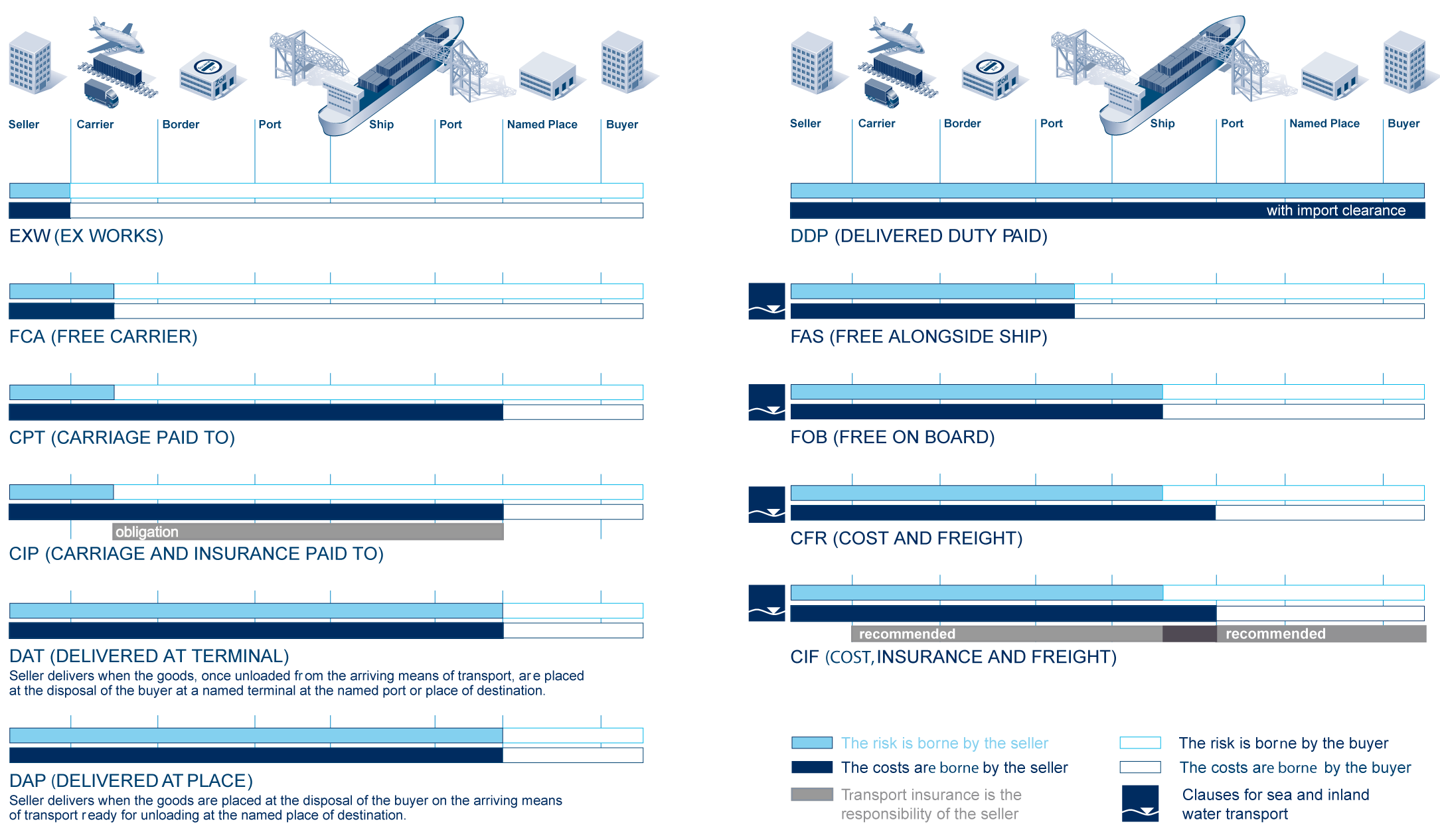


Incoterms are standard trade definitions most commonly used in international sales contracts. Devised and published by the International Chamber of Commerce, they are at the heart of world trade.
Among the best-known Incoterms are EXW (Ex works), FOB (Free on Board), CIF (Cost, Insurance and Freight), DDU (Delivered Duty Unpaid), and CPT (Carriage Paid To).
ICC introduced the first version of Incoterms - short for "International Commercial Terms" - in 1936. Since then, ICC expert lawyers and trade practitioners have updated them six times to keep pace with the development of international trade.
Most contracts made after 1 January 2000 will refer to the latest edition of Incoterms, which came into force on that date. The correct reference is to "Incoterms 2000". Unless the parties decide otherwise, earlier versions of Incoterms - like Incoterms 1990 - are still binding if incorporated in contracts that are unfulfilled and date from before 1 January 2000.
Versions of Incoterms preceding the 2000 edition may still be incorporated into future contracts if the parties so agree. However, this is course is not recommended because the latest version is designed to bring Incoterms into line with the latest developments in commercial practice.
| Group E - Departure |
| EXW |
Ex-Works (…named place)
Carriage to be arranged by the buyer from the seller’s door. Goods are
not cleared for export. Export charges are the responsibility of the
consignee. This is the minimum obligation for the seller.
|
|
| Group F - Main carriage not paid by seller |
| FCA |
Free Carrier (…named place)
Carriage to be arranged by the seller or the buyer on the buyer’s behalf.
Seller delivers goods to the carrier nominated by the seller.
|
| FAS |
Free Alongside Ship (…named port of shipment)
Seller delivers the goods alongside the vessel only. Buyer bears all costs
and risks from that moment onward.
|
| FOB |
Free on Board (…named port of shipment)
Carriage to be arranged by the buyer from port of departure. Only used
For ocean or inland waterway transport.
|
|
| Group C - Main carriage paid by seller |
| CFR |
Cost and Freight (…named port of destination)
Carriage to be arranged by the seller. Risk transfers from seller to buyer
once goods on board vessel. Only used for ocean or inland waterway
transport.
|
| CIF |
Cost, Insurance and Freight (…named port of destination)
Carriage and insurance to be arranged by the seller. Risk transfers from
seller to buyer once goods on board vessel. The seller must procure
marine insurance. Only used for ocean or inland waterway transport.
|
| CPT |
Carriage Paid To (…named place of destination)
Carriage to be arranged by the seller. Risk transfers from seller to buyer
once goods have been delivered to the first carrier (if more than one is
utilized).
|
| CIP |
Carriage and Insurance Paid (…named place of destination)
Carriage and insurance to be paid by seller. Risk transfers from seller to
buyer once goods have been delivered to the carrier. The seller contracts
for insurance and pays the insurance premium. CIP is only required to
give minimum insurance coverage.
|
|
| Group D - Arrival |
| DAF |
Delivered at Frontier (…named place)
Carriage to be arrange by seller. Buyer is responsible for all risk of
at the named place at the frontier, but before the customs border
of the adjoining country. Customs formalities are the responsibility
of the consignee for importation.
|
| DES |
Delivered Ex-Ship (…named port of destination)
Carriage to be arranged by seller. Risk transfers from buyer to seller once
goods are placed at the disposal of the buyer on board the ship. Seller
bears all costs to named port before discharging the goods. Customs
formalities are the responsibility of the consignee.
|
| DEQ |
Delivered Ex-Quay (…named port of destination)
Carriage to be arranged by seller. Risk transfers from buyer to seller once
goods are placed at the disposal of the buyer on the quay. Seller delivers
the goods to the named wharf or quay. Customs formalities are the
responsibility of the consignee.
|
| DDU |
Delivered Duty Unpaid (…named port of destination)
Carriage to be arranged by seller. Risk transfers from buyer to seller once
goods are placed at the disposal of the buyer. Seller delivers the goods
to the consignee’s door. Customs formalities are the responsibility of the
consignee.
|
| DDP |
Delivered Duty Paid (…named port of destination)
Carriage to be arranged by seller. Risk transfers from buyer to seller once
goods are placed at the disposal of the buyer. Seller delivers the goods
cleared for import to the consignee’s door. DDP represents the
maximum obligation for the seller.
|
|